
You know what flow feels like. Time disappears. The work moves through you rather than coming from effort. You’re not managing the task, you’re inside it. The inner critic goes quiet. The self-consciousness drops. Something takes over and produces better output than you could have manufactured by trying harder.
Most advice about getting there focuses on the wrong thing.
Remove distractions. Use the Pomodoro technique. Find your optimal challenge level. These are useful adjustments to the conditions around the experience. None of them address the one variable that decides whether flow is available in the first place: the state of your nervous system when you sit down to work.
What Flow Is
Mihaly Csikszentmihalyi spent decades researching optimal experience and gave us the term “flow” for the mental state in which people report peak performance and deep satisfaction. His research identified conditions that make flow more likely: clear goals, immediate feedback, a challenge level matched to your skill, and complete absorption in the task.
Those conditions are real and worth understanding. But they describe the cognitive environment for flow. The physiological requirement sits underneath them.
Flow requires a nervous system that is both activated and regulated at once. Alert enough to sustain focus and engagement. Settled enough that the threat-detection system isn’t consuming the resources that creative thinking needs.
That combination has a name in neuroscience: transient hypofrontality. During flow, activity in the prefrontal cortex decreases. This is the seat of the inner critic, the self-monitoring system, the part of you that second-guesses each sentence as you write it. The brain’s resources shift toward the areas handling sensory processing, pattern recognition, and automatic execution.
You can’t force prefrontal deactivation. You can’t will your inner critic to stand down. But you can create the nervous system conditions that allow it to happen on its own.

Why the Standard Advice Falls Short
Most flow-state guides are built around productivity and focus strategies. They’re not wrong, but they’re aimed at the ceiling of the experience rather than the floor.
The ceiling is the cognitive setup: the right task, the right environment, the right amount of challenge. When those are in place, flow becomes possible.
The floor is the nervous system baseline. If your body is in low-grade stress activation, the prefrontal cortex stays online in protective mode. The threat-detection system won’t stand down for a creative sprint. Your brain will generate options, then evaluate and dismiss them faster than they can develop. You’ll call it writer’s block or creative resistance. The mechanism is a nervous system running the wrong protocol for the task.
A dysregulated baseline means you’re not starting from the floor. You’re already elevated, already part-way into survival mode, burning the resources that flow runs on before the work begins.
The Nervous System Conditions for Flow
Two conditions have to be in place.
The first is regulation. The body needs to be in a state where it doesn’t read the work environment as a threat. For many people, the act of sitting down to create is associated with judgment, failure, visibility, or the gap between vision and execution. The nervous system learned to treat that territory as dangerous. Until the baseline shifts, flow in that territory stays out of reach.
The second is activation. Flow is not a passive state. It requires energy, engagement, and a degree of arousal in the system. The alpha-wave relaxation of deep meditation doesn’t produce flow. Neither does exhaustion. The ideal state for flow sits in a narrow band: regulated enough for the prefrontal cortex to soften, activated enough to sustain sharp focus.
The overlap between regulation and activation is exactly what a well-designed breathwork session produces.
Breathwork as a Pre-Flow Protocol
As a DJ, I’ve spent years designing the conditions for flow in other people. A room enters flow when the music moves from a grounding, settling tempo into a building activation that creates energy without overwhelm. The crowd doesn’t decide to enter flow. The sonic architecture creates the conditions and the nervous systems in the room follow.
The same principle applies to your own practice.
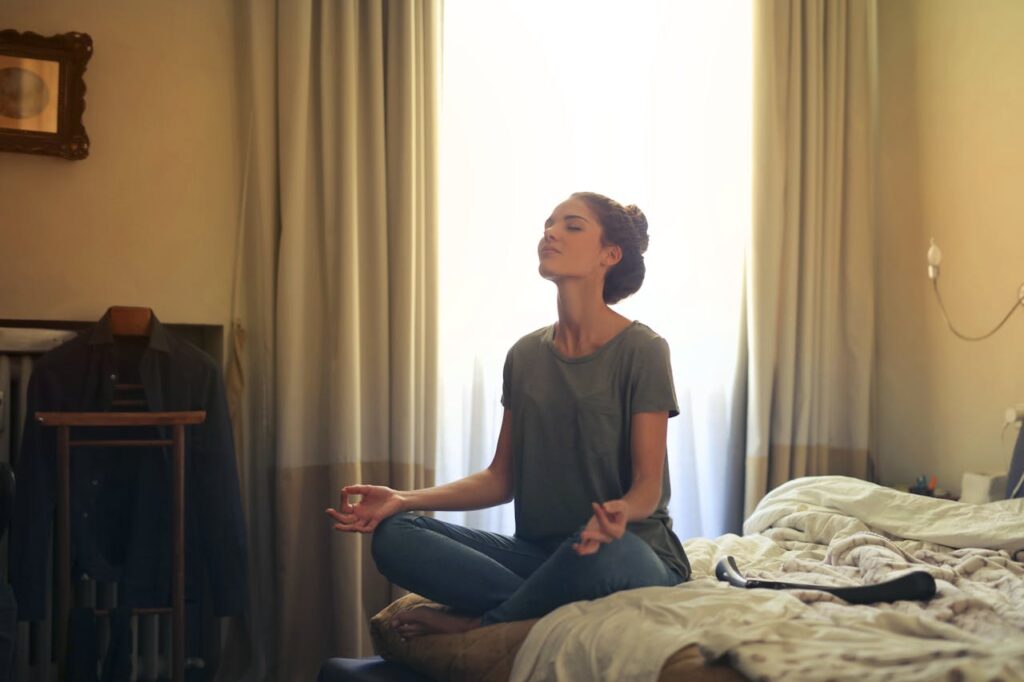
A breathwork sequence before creative work creates the nervous system state that makes flow available. Not guaranteed, but available. The difference between sitting down dysregulated and sitting down with a prepared nervous system is the difference between fighting for access to your own creative range and finding that the door is already open.
Here’s a sequence that works:
5 minutes of equal breathing. Nose in, mouth out, four counts each. This settles the baseline and signals the nervous system that the next hour is not a threat. The prefrontal cortex begins to relax its grip.
3 minutes of Breath of Fire. Rapid nasal breathing driven by the navel, roughly one breath per second. This activates without overwhelming. The warmth and alertness that follow are the body in the activation band that flow requires.
2 minutes of stillness. Stop the Breath of Fire. Breathe naturally. Notice the combination of warmth, alertness, and quiet. That combination is the nervous system in the pre-flow state.
Then open your work.
The inner critic hasn’t disappeared. But it has less voltage. The first move into the work carries less resistance. And in creative work, momentum from the first five minutes tends to compound.
The Deeper Practice
A ten-minute pre-work sequence changes the conditions for flow in the session that follows it. A sustained breathwork practice changes the conditions for flow in the life that surrounds it.
The first session gets you into the room. Weeks of consistent practice widens the door. After three months of trained nervous system work, the regulated-and-activated state that flow requires becomes more accessible without the explicit pre-work ritual. The baseline has shifted. Flow starts arriving in more domains, more often, because the system is no longer running a default of vigilance.
This is what the RISE 22-Day Program builds toward. Not flow as a productivity hack. Flow as a natural expression of a trained nervous system operating at the level it was always capable of.
Watch the Free Nervous System Masterclass →
Start the RISE 22-Day Program →
A note on practice. The breathing techniques and physiological information in this article are educational and not a substitute for medical advice. Breathwork includes intense breathing patterns and breath holds that are not appropriate for everyone. If you are pregnant or have a cardiovascular, respiratory, or psychiatric condition, consult a qualified healthcare provider before practicing. Read our full Medical Disclaimer.